• Skip to primary navigation
  • Skip to main content

Maidenhead Catenians

  • Home
  • About Us
    • Benefits of Fellowship
    • Who are the Catenians?
    • Maidenhead Circle
  • Joining Us
  • Socials & Events
  • Musical Evenings
    • Musical Evening – What is it?
    • Past Events
    • Our Next Musical Evening
  • Youth Support
    • Bursary Fund
    • Schools’ Public Speaking
    • Other Youth Support
  • Reflections
  • Contact Us
  • Links

Reflections

A Carpenter’s Marian Devotion

31 August 2026

Following the July dinner, President Jacek gave a presentation, illustrating his carpentry work at both Ealing Abbey and at Westminster Cathedral and his devotion to Mary.

The icon known as  Our Lady of Częstochowa or the Black Madonna is not only a significant religious icon but a national symbol for Poland of its nation and culture. The Black Madonna is said to have miraculously saved the monastery of Jasna Góra from the Swedish invasion in 1655.

Ealing Abbey had to be extensively renovated after World War II. As there was a large presence of Poles in the London Borough of Ealing, a wooden chapel featuring a copy of the original icon was erected in the Abbey.

Our Lady icon,Ealing Abbey – original wooden frame chapel

The original chapel was destroyed in the 1990’s as thieves tried to steal the votive offerings. Jacek’s friend Marek, a Polish Knight of Malta, was alerted and approach Jacek asking to use his carpentry skills to create a modern version of the chapel. Marek had already commissioned the new painting
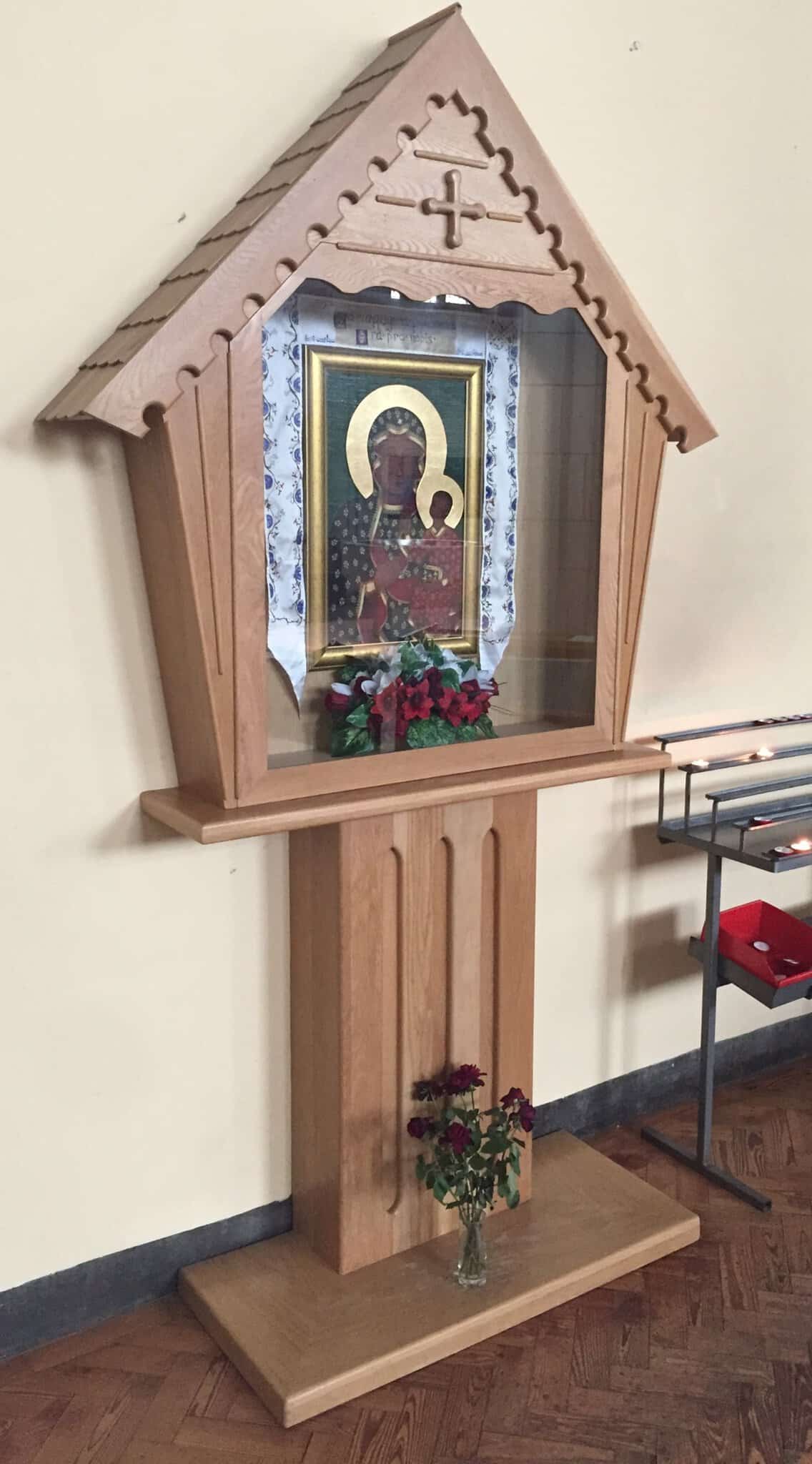
Our Lady icon, Ealing Abbey – new wooden frame chapel

***

Before the English Reformation, the major Marian site of devotion in England was at Walsingham. The original shrine was destroyed in 1538 during the Reformation under King Henry VIII. The historic statue of Our Lady was seized and taken to London to be burned.

Following the restoration of the Catholic hierarchy in England and Wales the ruined Slipper Chapel was restored in 1850. In 1922 a new Anglican vicar of Walsingham, Father Alfred Hope Patten, commissioned and enshrined a new, specially carved statue of Our Lady of Walsingham.

In 1954, Cardinal Griffin commissioned a new hand carved wooden copy of the statue of Our Lady of Walsingham to be placed in a position of honour in the Westminster Cathedral. The statue did not remain static, and extensive use resulted in widespread damage. Consequently, the statue was placed in the Westminster Cathedral Crypt out of public view.

Jacek’s friend Marek, who had already commissioned a replacement lily for the statue, alerted him of the situation and a new project began. The statue was fully restored and a new pedestal, based on a pre-reformation marble altar now in a church in Chipping Norton, was designed by Jacek. The Polish Knights of Malta commissioned an oak copy of the original.
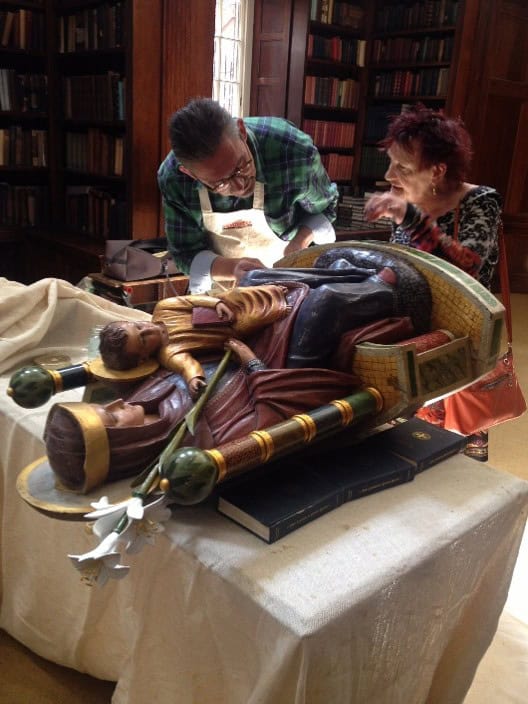
Jacek and his friend Sharon restoring the statue

In 2016, the statue of Our Lady of Walsingham was formally placed and enthroned in its permanent, prominent position in Westminster Cathedral’s Chapel of St George and the English Martyrs.

Our Lady of Walsingham in Westminster Cathedral

Whose Vernacular ? : April 2026

12 June 2026

On a recent visit to Rhodes,I thought afresh of the importance of the word and the vernacular.

The presence of the Knights Hospitaller of St John is expressed in the architecture of the Old Town of Rhodes. The Knights held Rhodes between 1310 -1522 , when following a successful siege by the Ottomans, they left Rhodes for Malta.

On Rhodes, the Knights were formed into eight groups, known as “Langues” or languages – not being a national but a linguistic grouping . Originally seven – Auvergne, France and Provence; Italy; Germany (covering the Holy Roman Empire and Scandinavia) ;England (including Scotland and Ireland); and Aragon ,with an eight later included to include Castile and Portugal.

The Street of the Knights, Rhodes – French Langue

In addition to their common bond as Christian Knights, the members of each Langue were further bonded by their Langue.

The Knights have long since left Rhodes but there is still a Catholic presence in Rhodes. As the Knights came from afar, so too do many who attend the two Catholic churches in Rhodes town… and the churches there cater for them.

St Francis -Prayer shown in several languages

Greek is the language of Rhodes and the mass is said in Greek. However non- Greeks are catered for by:-

  • although primarily in Greek, the ritual of the mass is universal and one can therefore follow where in the mass one is at;
  • there is one Greek section that non Greeks understand – Kyrie eleison;
  • parts of the mass in Latin;
  • Mass booklets showing the mass in various languages such as German, Italian and English on one page and Latin on the facing page;
  • the homily being given in both Greek and English.

To my great surprise, Confession was also offered in several languages.

Confession -choose your langauage.

A Maltese Pilgrimage

29 October 2025

Most people plan a pilgrimage, such as to Lourdes or Fatima, in advance. Sometimes though, a pilgrimage can be more spontaneous.

This Summer, we had a family holiday in Malta. Shortly before leaving, my wife mentioned to a friend that we were  staying at Mellieħa. “Oh” said the friend ,“are you making a pilgrimage to Our Lady of Mellieħa?” As we had not previously heard of Our Lady of Mellieħa, as a place of pilgrimage, that had not been our intention. However having now heard of this, we were intrigued to discover more.

On the transit coach from the airport to our hotel in Mellieħa, my wife asked the guide about this. Although he had been on the island for 10 years, he had not heard of this. Surely someone at our hotel would know but when we asked the receptionist, she too was unaware of it.

Our Lady of Mellieha Sanctuary Courtyard, looking up to main church.

It was therefore to our great surprise that we discovered the Sanctuary of Our Lady of Mellieħa only a couple of hundred yards from our hotel. Christian devotion here goes back to the dawn of Christianity in 60 A.D. As described in the Acts of the Apostles, the boat taking St Paul as prisoner to Rome was shipwrecked off the coast of Malta. Tradition has it that St Paul, with his companion St. Luke, initially sheltered in a cave at Mellieħa. It was here that St. Luke is said to have painted a fresco depicting the Virgin Mary on the cave’s rock face. This would have been one of the earliest depictions of Mary, by one who had met her.

Icon of Our Lady of Mellieħa

The original fresco has long since gone but above the altar in the Sanctuary is an icon of Our Lady, believed to date from the eleventh century. The fascinating question is the extent to which this icon might replicate and resemble that original fresco and how far therefore, we can glimpse how Mary herself looked. My wife observed the Mary depicted looked more Middle Eastern than the more European image often shown.   It is a miracle that we still have this icon. In 1614, the church was sacked during an  Ottoman attack and the fresco was damaged but fortunately it was the lower half.

The lay-out of the site is a bit confusing. Across the road from the Sanctuary, down 78 steps, one finds the Grotto . Although this is a place of prayer and looks as if it might be the cave where St Luke painted his fresco , it dates from the seventeen century and is not that cave. That cave has now become the Sanctuary chapel where the icon is.

High above the Sanctuary is the main church. On the Sunday we attended mass, local people were in the bigger main church where the mass was in Maltese.

Altar of the Sanctuary of Our Lady of Mellieħa

We felt blessed to attend a mass in English in the Sanctuary – the icon of Our Lady above the altar at one end of the church, the doors wide open at the other end of the Sanctuary -looking out over the sea – Stella Maris.

Looking out to sea

August 2025 Jonathan Holder

Catenian Bursary Fund: My Panama Project

11 October 2025

Details;

Project aim: improve the access to education in a remote province of Panama – El Valle de Anton.
Project Organiser: Challenges Abroad
Catenian donation: £400

Motivations;

Having participated and won one of the Catenian’s regional public speaking competitions, was the first time I was made aware of the Bursary Fund. I have always felt a responsibility to help others, primarily founded by the warm Catholic environment my school, St Josephs RC High School (Slough), fosters within us. One biblical teaching always stuck out to me and that was “Faith itself, if not accompanied by action is dead” (James 2:17). To me, it suggests us, as Catholics, have the innate duty to actively serve others with love, care, compassion and dignity, and I thought this could be achieved in no better way than through helping young, impoverished children, in local primary schools.

Project Delivery;

Organised heavily in conjunction with my school, and several other Catholic schools in our academic trust, we were able to fundraise enough money to send 15 young Catholics, including myself, to Panama to deliver English workshops in two local primary schools in a remote town called El Valle de Anton, located in the Cocle province.

A typical daily itinerary was usually like this;

6am – Wake-up
7am – Breakfast
8am – 12pm teaching in school
1pm – Lunch
2pm – 7pm miscellaneous activities, such as workshop planning, hikes, bike rides, karaoke to name a few

8pm – Dinner
10pm – Curfew

From the first day we arrived, we were instantly in the classroom helping to deliver English workshops. Topics included body features, movement, conservation, recycling and many more. The years we taught spanned from kindergarten to grade 9, which in age roughly translates from 5 to 15 years old.

As seen in the pictures, I think the workshops were a major success, and I do not want to estimate how many hugs and high-fives we received during the entire duration of our trip. In total we spent roughly 4 hours each day teaching, usually each lesson lasting from an hour to and hour and a half. There were two primary schools, one large one (approximately 400 students) and one small one (150 students). Classes tended to vary in size, but I would say on average there were about 15 children per class. We tended to split into groups of 3, so as to teach as many classes simultaneously without being overburdened by too many energetic kids running around.


Panama is also known for its large rainforests and incredible biodiversity, so we also spent a large portion of our time caring for and tending to the wildlife situated near us. One notable highlight was partaking in a night hike. Leaving at 10pm, we were guided through a remote trail and told to look out for as many strange creatures as possible. The wide variety of things we saw was magnificent and made me more aware of the beauty of our natural world. Some things pictured included snakes, hummingbirds, frogs and geckos.

We also helped more generally in the local community. For example, we spent a few hours each week at the recycling centre helping to sort plastics and bottles into separate piles ready for collection and reuse. The people is what made this trip so enjoyable, as the entire local community were so incredibly welcoming and made us feel like local celebrities. On numerous occasions, we would find ourselves playing football with the locals, trying local street food, or even being given souvenirs all because the people there felt gratitude for what we were doing.

One of my favourite highlights was visiting one of the most beautiful churches I have ever seen. Coincidentally named Parroquia San Jose (the church of Saint Joseph) its design was intricate and flawless. Catholic faith permeates in Panama, as a large percentage of the population are Roman Catholic. When I asked some of the children I was teaching what it meant to be Catholic, their responses were heartwarming. One that will stick in my head is “Being Catholic means my faith is part of who I am. Its not just about going to church, its about how I live: being loving, kind, caring to those around me. I like knowing I am part of that tradition”.

Spiritual / General overview;

I cannot put into words what an unbelievable, rewarding and enriching experience it was. Being able to plan and deliver English workshops to several different classes spanning a wide age range and topics, I truly cannot fathom in words how much happiness it brought me. To be honest, I was quite scared going into this trip as unsure of what to expect. But, from the first day, seeing the smile I was able to put on their faces made this whole experience worth it. While exhausting, it was without a doubt the most rewarding thing I have done probably in my entire life, and I would confidently say I am not the same person I was when I first embarked on it.

Spiritually, I feel I have put my Catholic faith into meaningful, impactful action. This trip, and your organisation as the Catenians, is what gave me confidence to apply for head boy, of which I was successful. I look forward to improving the Catholic environment of our school to encourage others to take part in experiences like this.

I would implore anyone who even has the slightest motivation to go volunteering to do it, even if you are quite young (in my case 17). The Catenians’ financial support made this possible, and I will be forever grateful for the lifelong memories I was able to make. I am sure this will not be my last report I will be making for you, as I am sure I will want to take part in more volunteering ventures in the future.

Cameron Fyfe August 2025

Copyright © 2026 · Maidenhead Catenians · Cookies · Powered by CatenianCircles.org.uk